
 Jesse Hitt • 14 May 2026 • 9 min read
Your HOA Needs a Website. Here’s How to Build One Easily

Key Takeaways
- A good HOA website keeps residents informed and self-sufficient, freeing HOA leaders to focus on decision-making and relational tasks.
- A great HOA website does more than meet legal requirements. It makes community life easier for residents and boards alike.
- The best HOA website is built into the same platform you use to manage your community, collect payments, and handle finances, whether that’s one community or fifty.
- An HOA website must offer public access to some content while restricting access to private documents and information.
- AI chatbots can serve as first responders to answer basic questions 24/7.

You agreed to join the HOA board because you care about your neighborhood. You didn’t agree to become its full-time help desk. But here you are on a Saturday morning, woken early by birdsong (nice), lawnmowers (loud), and the ding of an email notification (ugh). After fortifying yourself with coffee, you dare to check your inbox. Most new messages are from residents, the same questions you find yourself answering multiple times a week:
- What are the pool hours?
- Can I reserve the clubhouse?
- Where do I submit a maintenance request?
- When are dues due?
With a sigh, you refill your coffee and set about politely repeating yourself.
The problem is that your residents simply don’t know where to look for the information they need. If your inbox is overloaded and your days are bogged down by endless questions from residents, here is a solution to unclutter your inbox and your life. Build an HOA website.
A good website for any HOA will handle most of your community’s questions before they turn into emails or phone calls.
Forward-thinking boards have taken their solution a step further with an AI assistant that answers questions 24/7. With or without AI, a well-built site keeps residents informed and self-sufficient, freeing community leaders to focus on meaningful, relational leadership rather than basic Q&A.

Does Your HOA Need a Website?
Depending on where you live, your community organization may be legally required to have a website.
Florida, Texas, Nevada, and Wisconsin already mandate websites in certain cases. (See more specific details below.)
If you live in other states, you’re about two bad neighbor disputes away from wishing you had a website. (Maybe you’re already there.)
States with existing requirements
First, let’s clarify the laws for the four states that already mandate websites:
- Florida: HOAs with 100 or more parcels must maintain a compliant website or mobile app that provides password-protected access to documents, in accordance with Chapter 720. Condo associations follow similar rules under Chapter 718.
- Texas: POAs with 60 or more units or those using a management company must post governing documents electronically (Texas Property Code § 207.006).
- Nevada: HOAs with more than 150 units must maintain a secure website or portal with governing documents, meeting notices, and financial records (NRS 116.31069).
- Wisconsin: Associations with more than 100 units must maintain a password-protected website (Ch. 703.20).
The trend is moving toward mandates
Even if your state doesn’t yet require an HOA website, it may soon require one. The legal trend is moving toward mandates and transparency. Building a website now is smarter than scrambling to comply later.
Plus, building a website is about much more than legal compliance. Having an up-to-date website has become standard practice and a common expectation for most professional organizations. Most importantly, a website empowers HOA leaders to provide outstanding leadership by meeting (even exceeding) resident expectations, improving communication, and simplifying day-to-day tasks.
What Should an HOA Website Actually Include?
The real goal of an HOA website is to make community life easier and leadership lighter. Compliance is just the starting point. The right website can turn a disorganized community around. Instead of frustration and confusion, residents begin to feel informed, involved, and well-led. When community expectations are clear, and it’s easy for residents to request information or assistance, leaders build trust. A website can significantly simplify leaders’ tasks, freeing up their time so they can focus on effective decision-making, planning, and relationship-building.
What key elements comprise an effective HOA website? A website needs to handle two categories of information:
- Public-facing content
- Private content that only community members can see
Content that the public can access
Public-facing content is the information anyone can see. No login or password is required. The public portion of your site should include information such as:
- Community name, logo, and contact form
- Photos for potential buyers and new residents
- Amenity information (pool hours, gym access, clubhouse reservation process, etc.)
- Announcements and upcoming events
Content restricted to community members
When residents enter a password, they can access the private, members-only information that the rest of the world doesn’t need to see. This is where you post:
- Governing documents, like CC&Rs, bylaws, rules, and regulations
- Meeting notices, agendas, and minutes
- Financial statements and budget
- Links to pay dues, submit maintenance requests, or reserve shared spaces
- Access to an owner portal, where residents can log in to view their account history, set up autopay, and manage their household details without contacting the board
Notice how many of those items overlap with the kinds of questions you frequently get from residents? That’s no coincidence.
A good owner portal makes residents self-sufficient, and a good website points residents directly to that portal. Together, these tools enable residents to find answers, make payments, stay up to date on community changes, connect, and more.

The Problem with General-Purpose Website Builders
You might be tempted to turn to a general-purpose website builder. Tools like Wix, Squarespace, and WordPress are powerful and flexible, and they can build just about any kind of website you want. But customizing that website to meet a homeowners association’s specific needs is a complex undertaking, and most HOA board members aren’t web developers.
Building a fully functional community site from scratch on a generic platform takes time, technical know-how, and ongoing maintenance. Or it takes hiring someone who has all three. So either the volunteer who signed up to help their neighborhood ends up learning HTML or writing a check to a freelancer. And that’s just getting the site up and running.
Once the site is up, you still have to:
- Stitch together a separate payment processor for dues.
- Configure document storage with public and private access controls.
- Create and manage forms for maintenance requests and clubhouse reservations.
- Sync everything with your accounting or management software.
- Keep the site updated as your community changes.
That’s a lot of maintenance for a volunteer. AI is starting to close the gap, but at this point, AI’s shortcuts are most helpful to people who already know their way around the technical side of web development.
A purpose-built HOA platform skips the setup work entirely. The pieces are already connected, and the software is designed around the way community boards actually operate.
What if Your Website Could Answer Questions for You?
Setting up a website doesn’t magically empty your inbox. Even when your HOA has an effective website, residents will still have questions. Lingering questions mean HOA leaders could continue getting repetitive emails and texts: What’s the fence height rule? When does the pool close? When are dues due again?
AI technology allows an HOA website to answer questions, saving everyone time and confusion.
It works like this: An early-bird resident is heading out for her garden-store run on a Saturday morning and realizes she has a question about landscaping rules. Instead of emailing a board member, she types her question into the AI chatbot on the website. The bot searches the community bylaws and returns a swift answer. The resident heads to the store properly informed, and HOA leaders enjoy a peaceful, uninterrupted Saturday morning. Everyone is compliant. No one is bothered.
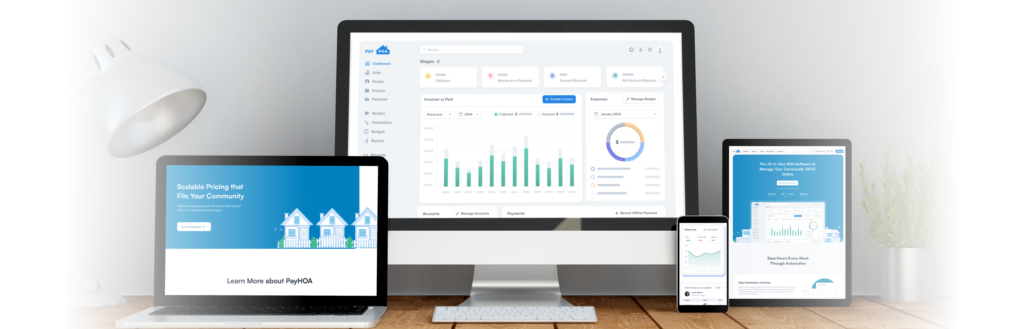
Communities that use PayHOA can design a free, customizable website through the PayHOA website builder.
And that advanced chatbot technology? Our users can turn on an optional chatbot assistant named Penny. Once the board uploads the community documents, Penny reads them, and residents can ask questions 24/7. All conversations are logged in the PayHOA inbox so leaders can follow up if needed.
Penny has limits, like any chatbot. She’s built for factual questions about rules, policies, and the calendar. Think of her as a first responder, fielding routine tasks (upcoming meetings, policies and procedures, amenity hours, due dates, and the like) so board members can focus on the calls that require human judgment.
What to Look for in an HOA Website Builder
If you’re ready to offer your residents a professional website, the next step is choosing a website builder. What should you look for to ensure the process is painless and the final product is professional? Here are a few key features to look for in a website builder:
- Built-in document storage with access controls (translation: some documents are public, while some are for owners’ eyes only)
- Integration with your payment and management tools (meaning the website and back office work together)
- A customizable site that reflects your community
- A site that can be easily edited and updated (no coding or tech experience required)
- An owner portal that handles payments, account history, and requests, so residents rarely need to call
- HOA website hosting for ongoing maintenance and support
- Multi-community capability (so property management companies can build and run sites for every association they serve, without starting from scratch each time)
- AI chatbot capability trained on your community’s documents
PayHOA offers all these features and much more. Our website builder and owner portal work together to provide all the tools you need to manage your community effectively, efficiently, and professionally. Property management companies get the same toolkit across their entire portfolio, with one place to launch and maintain sites for every association they serve. If you’ve been drowning in to-dos, juggling a patchwork mess of ledgers, platforms, and software, you can bring everything together onto a single, user-friendly platform.
Less Inbox, More Leadership
A purpose-built website changes what’s possible. Volunteer boards reclaim their Saturdays. Management companies deliver professional sites across every community they serve, without starting from scratch each time. Either way, you’re spending less time on busywork and more time leading your community well.
See what PayHOA’s website builder can do for your community.
Share this article:
Enjoyed this Article? Try Another!

HOA Communications and Rule Changes: How to Communicate Without Backlash
Key Takeaways A new landscaping rule lands in community members’ inboxes on a Saturday morning…
The Guide to Missouri HOA Laws
Key Takeaways Serving on your HOA’s board means knowing more than the association’s declaration, bylaws,…

HOA Accounting Basics: How to Read Financial Statements, Reconcile Accounts, and Build Report Packets
Key Takeaways Most volunteer board members inherit a financial system with no documentation, no training,…