
 Jesse Hitt • 21 May 2026 • 8 min read
HOA Meeting Minutes: What to Document and Why

Key Takeaways:
- HOA minutes create an official record of board decisions, votes, and follow-up responsibilities.
- Meeting minutes protect continuity, so future boards can understand what happened and why.
- A clear HOA meeting minutes template helps boards document the right information without turning minutes into a transcript.
- Organized records support transparency, reduce repeat questions, and help the board respond confidently during disputes.

Why HOA Boards Keep Meeting Minutes
Good meeting minutes are routine now and essential later. They give homeowners a clear window into how decisions are made, how funds are allocated, and how the board follows through on community priorities.
For volunteer boards, minutes also bring order to HOA Management. A well-kept record shows that the board met properly, reviewed the right information, voted on key issues, and assigned next steps. That kind of documentation builds trust because homeowners can see a process, not just a result.
Minutes also protect continuity. Board members rotate off, neighbors move, vendors change, and memories get fuzzy. A clear record keeps the community from having the same debate every year because no one can find the original decision.
If a serious issue arises, such as a budget challenge, an enforcement dispute, or a leadership question, HOA minutes provide the board with a necessary paper trail. That record can help show that decisions were handled with care, consistency, and proper authority.
This blog includes a downloadable HOA meeting minutes template. Click the button below to jump to the download at the bottom of this page.

What Are HOA Meeting Minutes?
HOA meeting minutes are the official record of what happened during an association meeting. They document actions taken by the board or membership, including motions, votes, approvals, and assigned follow-up items.
They’re not a transcript. They don’t need every comment, side conversation, or debate captured word for word. Strong minutes focus on decisions and outcomes. Think of them as the board’s legal and historical record, not a play-by-play of who said what.
A clean, objective record is easier to approve, store, and rely on later.

Meeting Minutes Matter More Than You May Think
Minutes often feel like a formality until the board needs them. Then they become one of the most valuable records in the association.
Minutes support transparency. Homeowners want to know how their dues are being used, especially when the board discusses budget increases, repairs, insurance, or reserve planning. Minutes show that financial reports were presented, reviewed, and connected to board action.
They preserve continuity. Without clear records, future boards may revisit old decisions, undo settled work, or spend hours piecing together what happened from emails and hallway conversations. That creates frustration for everyone, including homeowners who thought an issue was already resolved.
Minutes also support legal defensibility, and in some states, they’re required by law. Florida, Texas, Wisconsin, and Nevada are among the states with statutes governing what HOA boards must record. If a board decision is challenged, objective records may help show that the board acted with due diligence. Because state laws and governing documents vary, boards often work with association counsel on specific questions. The principle holds everywhere: clear records serve the community better than scattered notes and memory.

What Types of HOA Meetings Require Minutes?
Annual meetings usually require minutes because they often include board elections, budget approvals, major owner votes, or important community updates. These minutes help document who attended, whether a quorum was met, and what official actions occurred.
Regular board meetings also need minutes. Whether the board meets monthly, quarterly, or on another schedule, these sessions usually cover financials, vendor updates, maintenance needs, violations, resident requests, and policy decisions.
Special meetings deserve the same care. These meetings address urgent or one-time issues, such as an unexpected repair, an insurance matter, or a time-sensitive contract approval. Because special meetings often occur outside the usual rhythm, minutes help demonstrate that the board handled the matter properly.
Executive sessions require a more careful touch. Boards may discuss legal matters, delinquency, personnel issues, or sensitive owner concerns in private. The minutes should generally note that an executive session occurred and document any final action allowed by the governing documents or state law, while protecting confidential details.
What to Include
Using an HOA meeting minutes template helps boards capture the essentials without over-documenting the conversation. The best minutes are organized, factual, and easy to review at the next meeting.
The basics
Start with basic meeting information. Include the association name, meeting type, date, time, location, and whether the meeting was held in person, virtually, or both. If the meeting was virtual, clearly document the platform or access method.
The administrative tasks
Next, confirm attendance and quorum. Minutes should name board members present, board members absent, and guests, such as a manager, attorney, accountant, or vendor. Quorum matters because the board needs a sufficient number of authorized participants to conduct official business.
The last meeting
Record approval of prior minutes. This often takes one line, such as, “The board reviewed the minutes from the March 12th meeting. A motion was made, seconded, and approved to accept the minutes as presented.” If corrections were made, note that the minutes were approved as amended.
The business
Financials deserve careful documentation. Minutes can note that the treasurer’s report was presented and reviewed, including references to the operating account, reserve account, budget-to-actual report, or delinquency summary when relevant. The minutes don’t need to reproduce the full financial report if it’s stored separately.
Old business should cover unresolved items from prior meetings. Keep this section focused on updates and decisions. For example, if the board previously discussed a drainage repair, the minutes might note that vendor bids were reviewed and the board voted to authorize the next step.
Motions are the heart of HOA minutes. Record who made the motion, who seconded it, and the final vote count. For major decisions, include the approved amount, vendor name, contract term, or policy title.
Action items turn decisions into follow-through. Assign each task to a person, committee, or role, and include a due date when possible. This keeps the board from leaving good decisions floating in the air like a lost pool noodle.
What to leave out
Omit clutter. Skip verbatim arguments, personal insults, emotional reactions, and opinions from individuals. Those details can distract from the official record and create unnecessary risk. Omit side conversations that didn’t lead to a motion, vote, or assigned action. If a comment shaped a formal decision, record the outcome rather than every sentence that led to it.
Write HOA Minutes That Hold Up
Write minutes in the third person, past tense. Use neutral language, such as “the board reviewed,” “a motion was made,” or “the motion passed.” This keeps the record professional and reduces the chance that minutes sound biased.
Distribute minutes quickly
Distribute draft minutes soon after the meeting while memories are fresh. Many boards share them by email or through a resident portal for board review before formal approval. Once approved, the minutes should become part of the association’s permanent records.
Store them publicly
Storage matters as much as writing. A board using HOA self-management tools can keep records organized in a single central location rather than relying on personal folders, inboxes, or old laptops. A community using an HOA website builder can also make approved records easier for residents to find, depending on the association’s access rules.
Formal approval should happen at the next appropriate meeting. Once approved, the secretary or designated officer can sign or certify the minutes in accordance with the board’s process.
Free HOA Meeting Minutes Template
Use this free HOA meeting minutes template as a starting point for regular board meetings. Adjust it to fit your governing documents, state requirements, and association practices.
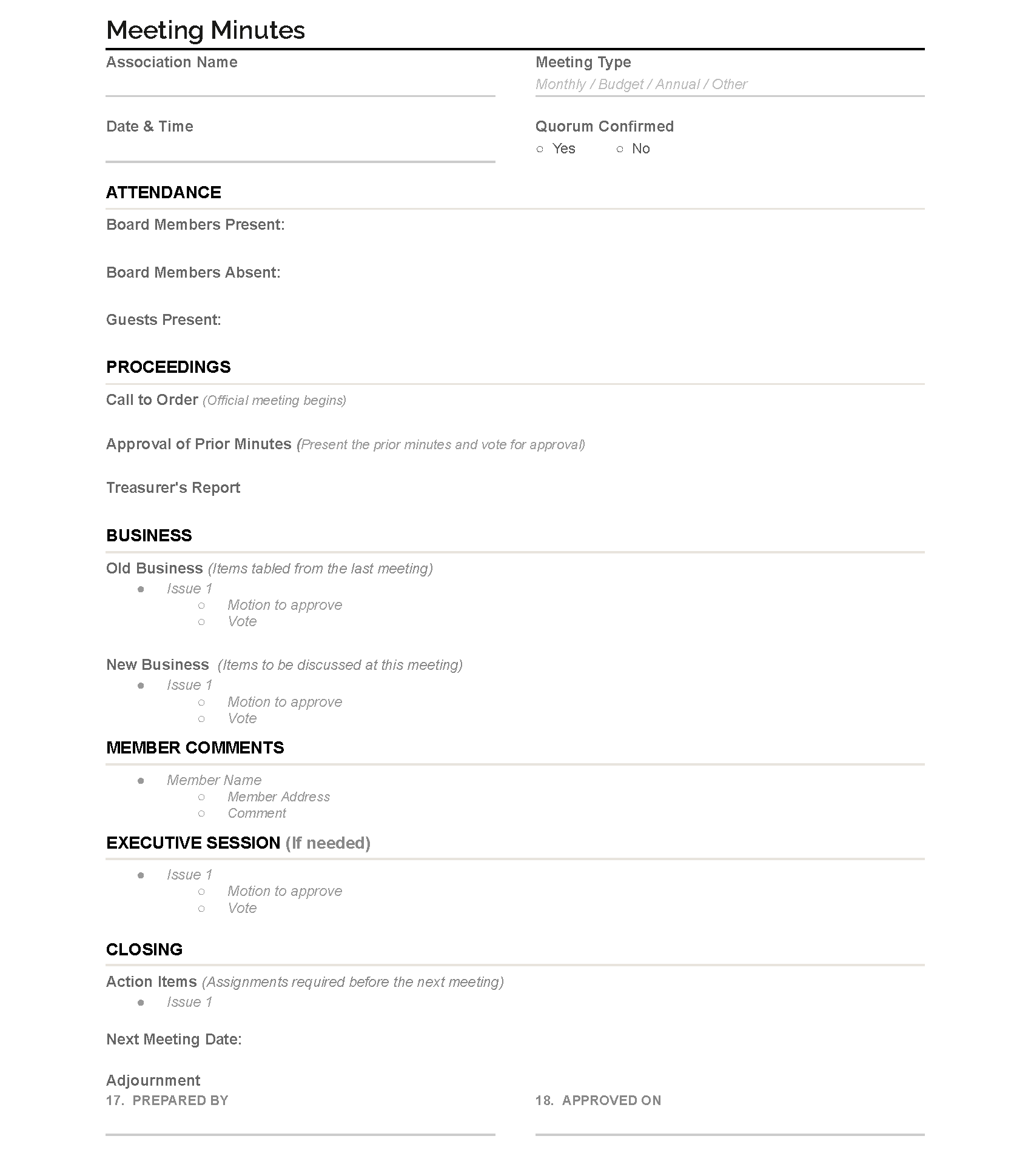
This simple HOA meeting minutes template gives the board a repeatable structure. It also helps new secretaries step into the role with more confidence and fewer blank-page jitters.
How PayHOA Helps Boards Keep Records Organized
PayHOA helps boards keep important records in one secure, cloud-based system. Minutes, financial reports, governing documents, vendor files, and owner communications can be kept in a central location rather than scattered across personal computers and inboxes.
Residents can access approved documents through the portal when the board chooses to make them available. That reduces one-off requests and gives homeowners a clearer sense of what the board has documented.
PayHOA also helps boards follow through after the meeting ends. Tasks pulled from the minutes, resident communications, and supporting documents all live in one place, so nothing important gets lost between meetings. That kind of structure makes minutes more than a record. It makes them the starting point for the work that follows.
HOA management software makes your volunteer job simple and fast, not time-consuming and error-prone. Get started today with a 30-day free trial. Sign up now.
Share this article:
Enjoyed this Article? Try Another!

HOA Voting Rules Every Board Should Know
Key Takeaways HOA voting rules come from two places: your state laws and your governing…
HOA Special Assessments: When They’re Necessary and How to Communicate Them Without Losing Trust
Key Takeaways An HOA special assessment is a one-time charge to owners when the association…

What Is a Convenience Fee? Surcharges and Convenience Fees Explained
Key Takeaways It’s a fair question, and the answer depends on which charge you’re talking…