
 Jesse Hitt • 09 Dec 2025 • 9 min read
Are HOAs Legally Required to Have a Website?
Key Takeaways
- Most states do not legally mandate an HOA website, but a growing number of states (like Florida, Texas, Nevada, and Wisconsin) require websites for associations over a certain size.
- The requirement for most HOAs is transparency and document accessibility, for which an HOA website is the most efficient solution.
- An effective website should be integrated into your overall HOA software platform to ensure compliance and privacy through a single, secure owner portal.

Does our HOA Need a Website?
Running a homeowners’ association is a considerable task. Volunteer leaders and board members may enter their roles with willing hearts but limited management experience. Maybe you stepped in because you like connecting with your neighbors and helping your community. You may not have experience in website design or an accounting degree, but you are willing to learn and eager to serve. Perhaps you envisioned yourself planning fun neighborhood get-togethers, but then you faced a jarring realization: community association leadership is much more than event planning. HOA leaders also handle complex tasks and legal responsibilities. The learning curve can be steep, even overwhelming at times.
In this guide, we’ll set you up for success by answering an important question: Are HOAs legally required to have an HOA website? And regardless of whether or not a website is required in your area, we’ll explore the benefits of establishing a website and turning to HOA software for a more comprehensive, integrated HOA management solution.

What are the Legal Requirements for an HOA Website?
Because HOAs are overseen by state governments, there is no one-size-fits-all answer to that question. Laws are constantly changing, but most state statutes focus on a core requirement: making official records, governing documents, and financial reports readily available to residents. In some states, particularly for larger communities, “readily available” has been legally redefined to mean a website or secure digital portal. For example, in Florida and Texas, a website is explicitly required for HOAs and COAs over a certain size threshold.
Let’s break down significant state laws more specifically:
Florida
House Bill 1203 (HB 1203/FS 720.303) amended Florida Statutes Chapter 720.303(4)(b) significantly. This bill went into effect on January 1, 2025. Key changes include:
- HOAs with 100 or more parcels must post certain official records on a website or mobile application.
- Condominium associations (COAs) with 25 or more units have similar requirements under FS Chapter 718.
- The website must include a secure, password-protected owner section where official records, such as governing documents, board meeting notices, and contracts, are posted.
Texas
The Texas Property Code § 207.006, Online Subdivision Information Required, mandates that Property Owners’ Associations (POAs) with 60 or more units, or those maintained by a management company, must utilize an electronic source (like an HOA website) to post dedicatory instruments (legal documents governing the establishment, maintenance, and operation of a planned community).
Nevada
Nevada Revised Statutes Chapter 116 mandates that Common Interest Communities (HOAs and Condo Associations) with 150 or more units must maintain a secure website or electronic portal with minimum content requirements.
Wisconsin
Condominiums with 100 or more units must have websites that host a lengthy list of content.
General Trend
Even if your state doesn’t currently mandate a website, legal requirements are trending toward mandatory digital communication and transparency.

Why Should Every HOA Have a Website, Regardless of Its State’s Requirements?
Even though HOA websites are not yet required in all states, having one is a smart move and a wise investment for forward-thinking HOA boards. In a culture that demands instant information and quick communication, a website presence has become a basic expectation and best practice for all organizations.
Every HOA should consider establishing a website for several key reasons:
- A dedicated, secure website built into an HOA software platform is the simplest and most cost-effective way to meet legal transparency obligations.
- A robust website, working alongside software specifically designed to meet HOA needs, does more than make documents available. It also empowers efficient management from a single, organized location.
- With the right software, leaders can work from a single hub to handle accounting, payments, voting, vendors, maintenance, communication, and more.
Why Should Our HOA Website Be Part of Our HOA Software?
Boards often consider standalone website builders (like Wix or Squarespace), but these platforms can create compliance risks and management headaches. Here are a few of the difficulties:
- The Integration Problem: A standalone website is completely disconnected from accounting, payment, and resident database systems. This requires double data entry and increases the risk of error.
- Compliance and Security Issues: When your website is integrated into your HOA software, the secure owner portal automatically links to verified resident data, financial ledgers, and official documents, ensuring full compliance and eliminating manual data transfer.
- A Piecemeal Workflow: When your website functions independently, workflow takes place on multiple platforms. You’re constantly transferring work and information from one place to another, risking mistakes with every transfer.
- An Unnecessary Headache: Most people lack the technical skills to build a website, and they don’t want to spend weekends nursing coding-induced headaches as they attempt to manage a website themselves. When you turn to an integrated platform like PayHOA, all the work of building and managing your website is done for you.
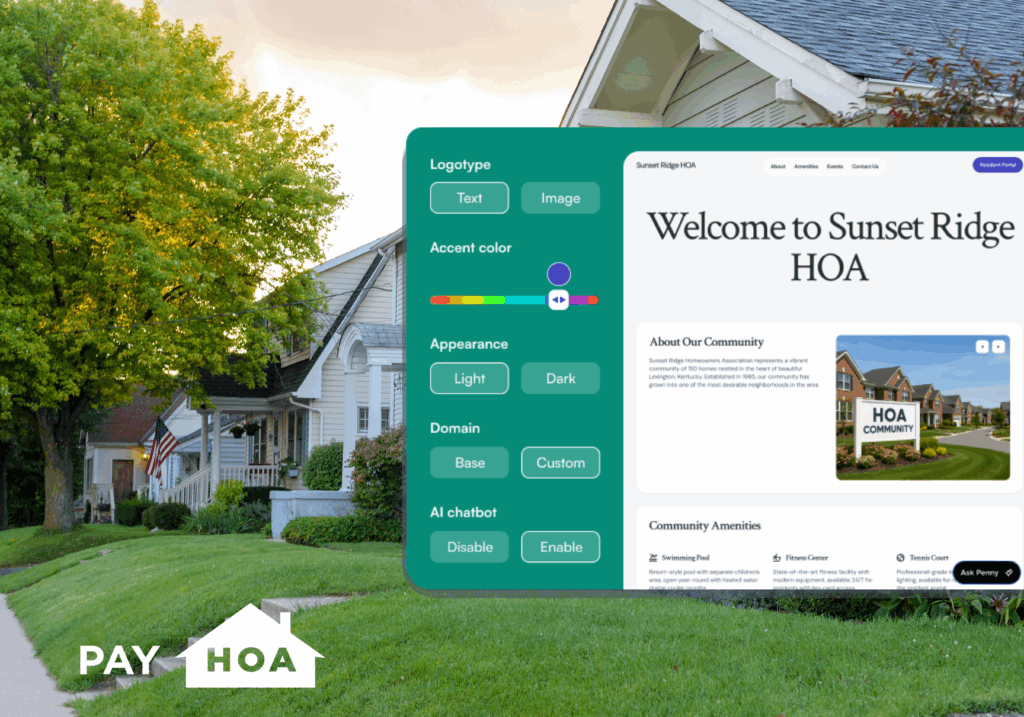
A website built into your HOA software keeps your data secure and consolidates your workflow in one place, saving your volunteers time and effort. PayHOA provides a professional, operational website for your community that is easy to build—in fact, it takes less than five minutes to set up. It is supported by supplemental resources, such as an AI chatbot, to keep your community connected and informed.

What Are the Must-Have Features for a Compliant and Effective HOA Website?
If your team is thinking, “We just need a basic website to house documents and static information,” think bigger. The right software can help your website (and leadership team) accomplish so much more.
Software like PayHOA can set up an informative, interactive site to function as your community’s central hub for communication, payments, maintenance needs, voting, surveys, and more. What are an HOA website’s must-have features?
Essential Features for Compliance
- A Secure Owner Portal: This is the most critical feature for compliance. The owner portal is where your HOA stores documents such as detailed financials, collection actions, and specific member data. To protect owners’ privacy and comply with laws regarding sensitive documents, the portal must be password-protected and accessible only to verified owners or residents.
- Centralized Document Storage: You need the ability to upload, categorize, and control access to all governing documents (CC&Rs, bylaws), financial statements, meeting minutes, and reserve studies.
Essential Features for Effective Management
HOA software can equip your website with powerful features to support efficient, effective community management. Look for these key elements to streamline and simplify your tasks:
- Integrated Online Payments: The HOA software should seamlessly integrate with your association’s accounting system. This allows residents to make secure payments online and significantly reduces your administrative workload.
- Voting and Surveys: Your website should allow your HOA to host secure, traceable online voting and surveys, which significantly boost resident participation and provide an audit trail.
- A Centralized Communication Hub: No more Facebook groups, group texts, or mass emails that tempt Angry Neighbor Joe to hit “reply all.” Instead, your website can become the central place for announcements, calendars, and mass communications (both email and text).
- Optional AI Chatbot for Instant Answers to Basic Questions: PayHOA offers “Penny,” an optional AI chatbot that provides residents with immediate answers to basic queries. You upload your community documents, and Penny draws answers directly from those documents to answer questions like “When is the annual meeting?” “What are the clubhouse hours?” or “How do I report a community maintenance issue?” A record of all communications is preserved so you can follow up with more in-depth answers or clarifications if needed.
You don’t have to choose between facilitating legal compliance and supporting effective management; your website can do both. Put all those elements together, and you get a healthy, effectively managed community. In other words: happy residents and headache-free volunteers.
As you consider website solutions, look for a comprehensive HOA software platform like PayHOA, which includes a pre-integrated website builder. We won’t just help you set up a professional website; we’ll ease your workload in every area. Your team will have a single centralized system for financials, communication, and overall community management.
You’ll be able to:
- Store required documents and residents’ private information safely.
- Facilitate resident engagement through calendars, message boards, and private groups.
- Communicate clearly and conveniently across multiple preferred channels, including email, text, and phone.
- Provide a single source of truth for your community.
- Keep residents informed of meetings, updates, and events.
- Handle all your accounting needs in one place.
- Automate billing and payments to save everyone time.
- Trigger request and maintenance workflows.
- File taxes like a pro without an accounting degree.
You work hard performing tasks like these for your community. But a website powered by the right software can lighten your load so you spend less time on busywork and more time enjoying the benefits of a stronger community, a place you and your neighbors are proud to call home.

Get Ahead Whether You’re Mandated or Not
Even without legal requirements, maintaining an effective HOA website is now the expectation for a modern, well-run association. If building a website sounds intimidating and expensive, it doesn’t have to be. Building your community’s online presence is much easier than you think. And when you integrate your community’s site with your HOA software, you maximize productivity while minimizing your workload. You save time, enhance resident satisfaction, improve transparency, and thoroughly equip your community for continued success.
Are you interested in software for your self-managed HOA? Try PayHOA free for the first 30 days. Sign up today.
Share this article:
Enjoyed this Article? Try Another!

The State of Community and Association Management: Trends, Regulation, and Technology Shaping the Future
Executive Summary When community leaders are equipped with the right tools and direction, they can…

Beyond the Sign-Up Sheet: How HOA Software Can Simplify Amenities Scheduling
Key Takeaways The Calendar Problem Nobody Signed Up For Most boards adopt HOA Software to…

Streamline Resale Documents: How In-App Processing Saves Time
Key Takeaways When a homeowner decides to move out, the HOA board assumes responsibilities critical…