
 Julie Dietz • 15 Oct 2026 • 14 min read
HOA Voting Rules Every Board Should Know

Key Takeaways
- State law often sets the floor for association voting rules, and your governing documents fill in the rest. Where your documents are stricter than statute, follow your documents. Where they genuinely conflict, the statute wins.
- An election can’t just be fair. Voters also must believe it’s fair. Messy or undocumented processes can invite claims of mismanagement and challenges that undo the result.
- Many process issues are avoidable. Missed notices, ballots that don’t match the number of open board seats, or vote counts that weren’t observed are all common, preventable mistakes.
- Self-managed HOA software can move voting online, reducing administrative work and potentially improving turnout.

HOA voting rules come from two places: your state laws and your governing documents. State law usually sets the minimum notice required before a meeting where a vote is held and, in many states, the voting methods you may use. Your declaration, CC&Rs, and bylaws fill in the rest, including quorum and how many votes each unit carries. When your documents ask for more than the law requires, follow your documents. When the two genuinely conflict, the statute wins. The same is true for condo and property owner associations.
HOA elections should not be ad hoc affairs. Though the rules vary from state to state, most elections will follow a similar process. This post covers the mechanics and the processes that state law and governing documents leave to the board.
What Are the HOA Voting Rules for Elections?
Your HOA voting rules are typically set by state law or your governing documents. State law frequently, but not always, sets:
- Meeting notice: Most association votes occur at a meeting, so the notice sets the date on the calendar for the vote. Voting outside a meeting is permitted in some states, but it is subject to separate notice and consent rules. Legal notice rules differ by state. For example, Georgia requires 21 days’ notice for annual or regularly scheduled meetings and 7 days’ notice for special meetings if the association has adopted the POA Act. Washington requires 14 to 50 days. Check your state laws for requirements in your area.
- Voting methods: Many states allow electronic voting, which can make the process easier on owners. However, some states have restrictions on electronic voting. For example, California bans the use of electronic secret ballots for votes on regular or special assessments (Civil Code section 5105(i)).
- Anonymity and inspections: States may require or restrict anonymous voting and have regulations around who can inspect an election. California HOA laws, which include some of the more detailed election provisions we’ve seen, require ballots to be cast so that the voter’s identity remains confidential under Civil Code sections 5100 and 5115. Section 5110 requires an independent third party to serve as the inspector of elections and specifies who qualifies.
Stay up to date on your state statutes, as new HOA voting rules can be added over time. Everything missing from state law lives in your own paperwork: the quorum threshold, whether a vote follows the member or the unit, cumulative voting rules, and if proxies are permitted.
Quorum, Proxies, and Weighting Votes
Quorum
An HOA meeting quorum is the minimum level of owner participation required for the meeting’s business to count, votes included. It is typically set in the governing documents, and figures vary widely. If you fall short of your quorum requirement, the meeting cannot elect board members, which usually means adjourning, re-noticing, and trying again.
Low turnout is common. If your association keeps failing to meet quorum, it may be worth amending the quorum requirement in your documents. The Foundation for Community Association Research describes an association that solved a chronic participation problem by lowering its quorum requirement to 20 percent. Changing a threshold requires its own amendment vote, but it removes the obstacle for every vote after that.
Proxies and casting votes
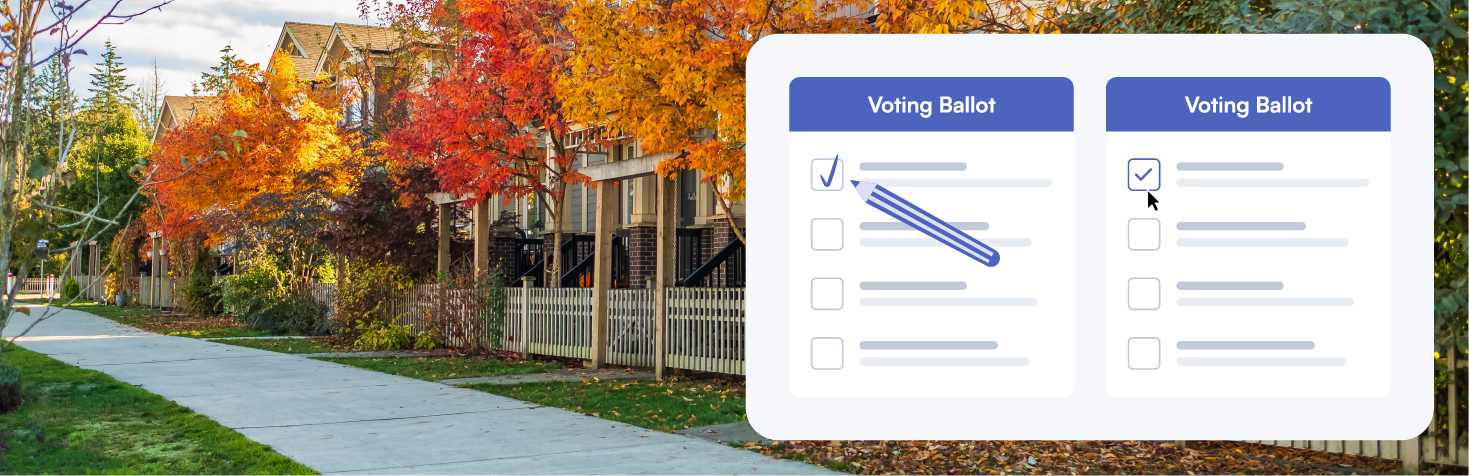
There are four possible methods for casting votes that are frequently confused with one another. Proxy voting in particular is often confused with voting by mail. Your association may use one or all of these depending on state law, governing documents, and what is being voted on.
| Instrument | What it is | Who may use it | What your documents must authorize |
| Proxy | A written authorization for another person to cast an owner’s vote at the meeting. | An owner who cannot attend and names someone to act for them. | That proxies are allowed, who may serve as one, how long they last, and how they are revoked. |
| Absentee ballot | A ballot the owner completes and returns before the meeting, voting directly rather than through a person. | An owner who cannot attend but wants to vote on the stated items. | That absentee voting is allowed, plus the return deadline and delivery method. |
| Electronic ballot | A ballot cast online through a secure link or an owner portal. | Any eligible owner, in states where electronic voting is permitted. | That electronic voting is allowed, and in many states that the owner consented to receive an electronic ballot. |
| Secret ballot | A ballot cast so the voter’s identity is not attached to their selections. | Any eligible owner, where the documents or the statute require confidentiality. | How anonymity is preserved and who may handle and count the ballots. |
Vote weight
Who gets how many votes is another of the most common sources of confusion we hear from customers. Typically, associations follow one of three voting setups:
- One vote per member – each owner casts one vote no matter how many lots they own.
- One vote per unit – each lot or unit carries one vote, so an owner of four units casts four.
- Votes weighted by allocated interest – votes are apportioned by square footage, percentage of common element interest, or assessment share rather than by unit count. Most common in condo associations.
Check your governing documents to find which setup your association uses, then make sure to communicate that to homeowners.
Formatting Your Ballots
Ballot design is one element that state law usually leaves alone. In most states, it is up to the board to structure the ballot correctly and make sure it matches what is being voted on. A few of the most common structures include:
- At-large ballots – every candidate appears on a single list, and voters choose up to the number of open seats. The candidates with the most votes win. For example, with three open seats and five candidates, each voter picks up to three names, and the three candidates with the most votes join the board.
- Per-seat ballots – each open seat gets its own race and its own section on the ballot. For example, Seat 1 is a three-year term and Seat 2 is a one-year term. Owners vote once in each race. Because each race is separate, one candidate could run for and win both seats. Decide how you’ll handle that before voting opens. Some associations require candidates to pick one seat. Others set a tiebreaker rule, like giving the winner the longer term and the other seat to the runner-up. Check your governing documents first, they may already cover it.
Votes on issues work the same way. A single question, such as approving a special assessment, gets a yes-or-no vote. When owners choose among several options, the ballot lists them all and owners pick one.
Whichever structure you choose, provide clear instructions and match the number of selections to the number of open options. We’ve seen associations forced to discard election ballots because the form allowed owners to select four board candidates when only three board seats were open, and there is no clean fix after the fact. Before anything goes out, confirm how many seats are open, how many candidates an owner may select, and what happens to a ballot that exceeds the limit. Include those details on the ballot in plain language.
Anonymous Votes and Counting Ballots
Two things vary by state and governing documents: whether the vote must be secret and who is allowed to do the tally. If a neutral party is required, a committee of owners who are not running is often the practical answer. For close races, a third-party inspector may be worth the cost.
A tip on fair elections from CAI: Let people watch. CAI’s Community Association Governance Guidelines recommend allowing each candidate a representative to observe the count. Counting in an open meeting is also a good option. By allowing people to watch or inspect the count, you increase transparency and trust in the results.

How to Build an Election Timeline That Holds Up to Scrutiny
The best HOA voting procedures consider legal requirements and owner sentiment, working on a timeline of events that helps everyone feel heard, included, and respected. Work backward from the meeting date, fill in your deadlines, and publish the finished calendar to owners well in advance so everyone who wants to participate can.
- Confirm open issues, seats, and eligibility. Identify what’s being voted on, how many board seats are open, the term length for each, and which owners are eligible to run and vote.
- Open nominations. Announce how owners can be nominated for board positions and the deadline, then send reminders when needed.
- Close nominations. Publish the final candidate list and any candidate statements so everyone gets the same exposure.
- Set the meeting date and the ballot deadline. Pick the meeting date first, then name the date and time ballots stop being accepted. For votes held at the meeting, that is usually the close of the vote at the meeting itself. Publish both with the ballot and do not move them.
- Send notice. Votes are frequently held at annual meetings, so your annual meeting notice anchors every other date. If the vote is happening outside of an annual meeting, other notice requirements may apply. Notice periods differ by state and by governing documents.
- Distribute ballots. Send them by the methods your documents allow and record what went to which unit and when.
- Collect and count. When the voting timeframe ends, follow the process you published, with your neutral counter and any candidate observers present.
- Publish results. Report the outcome, the turnout, and the vote totals in the detail your documents require.
- Record. Enter the results in the minutes and retain the ballots, notice records, and tally sheets for the period your state or documents require.
What Happens If Someone Challenges the Election?
Most challenges question one of five things:
- Whether notice was properly given
- Whether a voter or candidate was eligible
- Whether the meeting reached quorum
- How ballots were handled
- How the count was conducted
Communication and records matter more than most boards expect. If a candidate or voter has questions about how the election was handled, you should be able to show a clear record of the timeline, communication schedule, and vote setup. That may include a neutral counter who removed conflicts of interest, outside observers who can say what happened during the vote, and both ballots that let you reconstruct results.
If you receive a challenge, handle it the same way you would want yours handled: take it seriously. Put the objection on the record and respond in writing to the procedure you published. If the process genuinely failed, acknowledge the issue, make improvements, and, if necessary, redo the vote. Don’t defend a result no one trusts.
How HOA Voting Software Supports Free, Fair Elections
Elections can be tricky enough from an interpersonal standpoint, with candidates pitching ideas for change and perhaps criticizing the current leadership. The last thing you need is a complex or unclear election process that sows seeds of distrust or causes discord among neighbors.
The right tools bring election functions into one HOA app, so you spend less time on the mechanics and more on the outcome. Software can help:
- Save hours of work on administrative tasks
- Reduce election-related costs
- Increase accessibility and convenience with online voting
- Boost election turnout and community engagement
- Build trust by providing real-time election data and secure voting processes.
The best software will have several key features that support compliance with HOA voting rules and encourage engagement, including tools for surveys, voting, and communication.
Surveys and message boards
HOA software often has both survey tools and message boards that help candidates and homeowners connect. Survey tools can be configured to accommodate essay questions, allowing candidates to speak their minds on the issues facing the community.
For a more informal environment, message boards provide a convenient way for candidates to introduce themselves and share their plans to better the community. Prospective board members and officers can also answer questions from HOA members to support informed voting.
Online voting
Online voting is often easier for owners, and they’re more likely to vote. An owner traveling for work or living three states away can vote from their phone or laptop. Where turnout is the only thing standing between your board and quorum, that could decide whether the vote happens at all.
HOA voting software may also track quorum for you. You set the minimum number of votes a ballot needs to be valid, votes are tallied as they come in, and the system tells you when you hit that threshold, so you know before the close whether the vote will stand.
Broadcast and communication tools
Voting software that’s part of a larger HOA management platform can help with election communication. HOA software retains your owner list and communication preferences and provides shared tools like a calendar. A shared calendar can feature key dates, while mass communication tools can send notices directly to each member.
Mass communication tools may include broadcasting custom phone calls, sending text messages, and emailing all or a selection of your homeowners. Communication can be sent on demand or scheduled for specific days and times. Many associations also look for software that supports traditional mailings if online voting isn’t an option, making it easier to prepare and send physical notices and ballots.
Documentation and record keeping
Keeping everything in a single system of record is the greater advantage. Every message to homeowners lands in a single dashboard, so the notice history for an election is a two-minute answer rather than a time-consuming search through inboxes.
Frequently Asked Questions
Should homeowners be able to see vote counts before the election closes?
It depends. If your governing documents require visibility into in-progress work, make sure you provide it. However, many associations choose to hold per-candidate results until the count is complete. Seeing that turnout is still short of quorum could encourage the rest to participate. Knowing that one candidate leads by 20 votes could influence how owners vote.
How many votes does an owner with multiple units get?
Under the one-vote-per-unit framework, an owner of four units casts four votes. Under the one-vote-per-member framework, that same owner casts one vote. Check the voting section of your declaration or bylaws to see what’s required for your association.
What is cumulative voting, and how do we know if our bylaws require it?
Cumulative voting lets an owner concentrate all their votes on a single candidate instead of spreading one vote across each open seat. It gives a minority of owners a realistic path to a board seat. Search your bylaws for the word “cumulative” and accommodate it if required.
What happens if an owner votes for more candidates than there are open seats?
This depends on your governing documents and on the rulebook your bylaws name for running meetings. Some associations treat an overvoted ballot as invalid for that race, others as invalid entirely, so settle the rule in writing before ballots go out.
Who should run the election and certify it if current board members are candidates?
Someone with no stake in the result. That can be a committee of owners who are not running, a neutral election inspector, or your management company. Check your state law before confirming who will run your election in this scenario. Some states, California among them, bar anyone already under contract to the association from serving as inspector.
What do we do if the annual meeting does not reach quorum?
Check your bylaws for adjournment language first, because many associations may adjourn and reconvene at a reduced quorum requirement. Some states grant that right by statute regardless of what your documents say. If neither gives you an option, you need to re-notice and try again.
Is there free HOA voting software?
Yes, there are free HOA voting software options, although most are limited. The software may be free only up to a certain number of votes, or it may lack the functionality you need to document and run your election cleanly. For example, Election Runner offers free tools for up to 20 voters. Free software limits are too restrictive for most communities, however, especially when elections are subject to regulation from state law. Most associations choose to pay for HOA software that offers more robust voting tools to ensure they can communicate, run the vote, and record the results properly.

Free and Fair HOA Elections
An HOA is a legal entity with rights and responsibilities under the law. It’s also a group of people who share a common desire to improve and enjoy their neighborhood. Running a vote your community trusts isn’t glamorous, and it is mostly invisible when it goes right. Set the timeline before nominations open, publish it, follow it, and keep the records that prove you did.
Election tools built into the software you already use for dues and messaging beat a standalone voting product, because the owner list stays current on its own. PayHOA brings voting, communication, documents, and accounting together for 6,000+ associations. Try PayHOA free for 30 days and run your next election without disputes.
Share this article:
Enjoyed this Article? Try Another!
HOA Special Assessments: When They’re Necessary and How to Communicate Them Without Losing Trust
Key Takeaways An HOA special assessment is a one-time charge to owners when the association…

What Is a Convenience Fee? Surcharges and Convenience Fees Explained
Key Takeaways It’s a fair question, and the answer depends on which charge you’re talking…

The Guide to Tennessee HOA Laws
Key Takeaways Serving on a Tennessee homeowners association board, you’re used to being the last…