
 Jesse Hitt • 27 Aug 2026 • 7 min read
HOA Accounting Basics: How to Read Financial Statements, Reconcile Accounts, and Build Report Packets

Key Takeaways
- Regular bank reconciliation compares the internal ledger balance against the bank statement to catch discrepancies before they compound.
- The general ledger serves as the master record of financial activity, organizing every transaction by account category.
- A monthly financial report packet should include a balance sheet, an income statement, and a bank reconciliation summary to give the board complete transparency.
- Modern technology automates most backend data entry, shifting the treasurer’s role from manual ledger creation to review and financial oversight.

Most volunteer board members inherit a financial system with no documentation, no training, and no transition plan. Consider this the missing manual. HOA bookkeeping comes down to three repeatable tasks: recording transactions in a general ledger, reconciling that ledger against the bank statement, and packaging monthly reports for the board.
A volunteer with no accounting background can handle all three once they understand how to read HOA financial statements, what each task checks, and why it matters to the association’s financial health. Modern HOA accounting software automates the baseline data entry, so your job starts at review instead of a blank spreadsheet.
How to Reconcile Your HOA’s Bank Account
Reconciliation is a formal comparison between two independent records for the same period: your internal accounting records and your official bank statement. This verification confirms that every transaction is accounted for and that no unauthorized activity has taken place.
To complete a manual reconciliation, follow these four steps:
- Pull your official bank statement and the internal bank transactions ledger for the same date range.
- Mark off every transaction that appears in both records, leaving outstanding checks that have been issued but not yet cleared unmarked.
- Add back any deposits in transit that are not yet reflected on the bank statement, and subtract outstanding checks from the bank balance to calculate your adjusted bank balance.
- Verify that the adjusted bank balance and the adjusted ledger balance match exactly. Any remaining gap signals a recording error, duplicate entry, or unauthorized transaction that needs immediate investigation.
When the two numbers don’t match, the discrepancy usually stems from a few common failure points. Duplicate ACH entries from automated payment processing can double-record a single revenue stream. Checks recorded in the wrong accounting period or assessment payments credited to the wrong unit account will also throw off your numbers. These monthly checks are the foundation of managing HOA finances without losing sleep over missing funds.

How to Read an HOA General Ledger
If bank reconciliation is your double-check, the general ledger is the master record of all financial activity. The ledger details every dollar that enters or exits the association’s accounts.
Each line entry includes a date, a description, a debit or credit amount, and a running balance. Reading it effectively requires understanding what each debit and credit pair represents for that account type. Asset accounts, such as your operating checking account and your reserve fund, increase with debits. Liability accounts like prepaid dues or deferred assessments, along with equity accounts, increase with credits. Mixing up these opposite reactions is the most common non-software error volunteer treasurers make.
When a homeowner pays their monthly assessment, the entry debits the operating checking account to show the increase in cash. The matching credit depends on your accounting method. Under cash accounting, the credit goes straight to the assessment’s income account, so income lands in whatever month the payment arrives, and early or late payments can make a month look artificially high or low. Under accrual accounting, the income was already recorded in the month the assessment came due, so the payment credits accounts receivable instead. Either way, both sides of every entry must match for the ledger to stay balanced.
You don’t need to audit every standard transaction, but you should look for specific anomalies. Flag any line item with no memo or description, round-number amounts that don’t correspond to a known recurring vendor contract, and credits to income accounts in months when no assessments were due. Today the general ledger is generated automatically by specialized software, which means your primary job is reviewing it for logical consistency rather than rebuilding spreadsheets from scratch. Associations that want an expert double-check often pair their software with a dedicated HOA bookkeeping service to keep the books verified.

The Three HOA Financial Statements Every Monthly Packet Needs
A monthly financial report packet is designed to answer the board’s core financial questions for the period in one place. As a best practice, every packet should contain three foundational documents:
- The balance sheet: a snapshot of what the association is worth (equity) including assets owned, cash, reserve balances, and accounts receivable, versus what it owes, such as accounts payable and prepaid dues, on a specific date.
- The income statement: revenue collected versus expenses paid for the period, compared line by line against the approved annual budget so variances are immediately visible.
- The bank reconciliation summary: confirmation that the cash line on the balance sheet is backed by a verified bank balance, proving the ledger matches reality.
Once a treasurer knows how to read HOA financial statements like these, the packet stops being paperwork and starts being an early warning system.
How to Build a Stronger Monthly Report Packet
Strengthen the core packet by adding an accounts receivable aging report to track which units are delinquent and by how many days. A comparison of your current reserve fund balance against your official reserve study projections also helps with long-term planning. Distribute the completed packet to the board at least 48 hours before the scheduled meeting so everyone arrives informed.
If your board struggles to find time to compile these summaries, professional help makes a real difference. PayHOA’s bookkeeping services offer tailored support that takes the administrative burden off your volunteers while maintaining total transparency.
Frequently Asked Questions
How often should an HOA reconcile its bank account?
Monthly, without exception. Ideally, the reconciliation should be completed or reviewed by someone other than the person who recorded the transactions during that period to maintain proper financial controls.
Does a small HOA with 20 units need a formal chart of accounts?
Yes. Even the smallest association needs a formal chart of accounts. Separating reserve contributions from daily operating income is critical to avoid misreporting the association’s true financial position.
What is the difference between cash-basis and accrual-basis HOA accounting?
Cash-basis accounting records revenue and expenses only when money physically moves into or out of the bank accounts. Accrual-basis accounting records revenue when it is earned and expenses when they are incurred, regardless of when cash changes hands.
Are specific financial reports legally required for HOA boards?
Maybe. Financial reporting requirements vary significantly by state. Board members should consult local legal counsel and reference resources like the Community Associations Institute to confirm compliance with local statutes. For broader accounting standards, boards can reference the AICPA, and federal filing requirements like Form 1120-H are covered on the IRS site.
Shifting from Data Entry to Financial Oversight
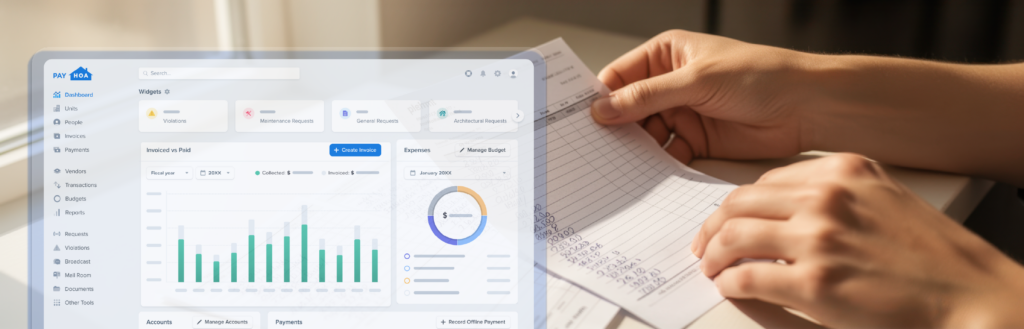
Mastering this cycle prevents minor data errors from compounding quarter to quarter and keeps your community clear of financial risk. When the ledger, reconciliation, and reports are generated automatically, the volunteer treasurer’s job shifts from tedious data entry to reading HOA financial statements with a strategic eye.
Want the whole cycle handled for you? Learn more about PayHOA’s bookkeeping services, or try PayHOA free for 30 days and see the reports build themselves.
Share this article:
Enjoyed this Article? Try Another!

HOA Voting Rules Every Board Should Know
Key Takeaways HOA voting rules come from two places: your state laws and your governing…
HOA Special Assessments: When They’re Necessary and How to Communicate Them Without Losing Trust
Key Takeaways An HOA special assessment is a one-time charge to owners when the association…

What Is a Convenience Fee? Surcharges and Convenience Fees Explained
Key Takeaways It’s a fair question, and the answer depends on which charge you’re talking…